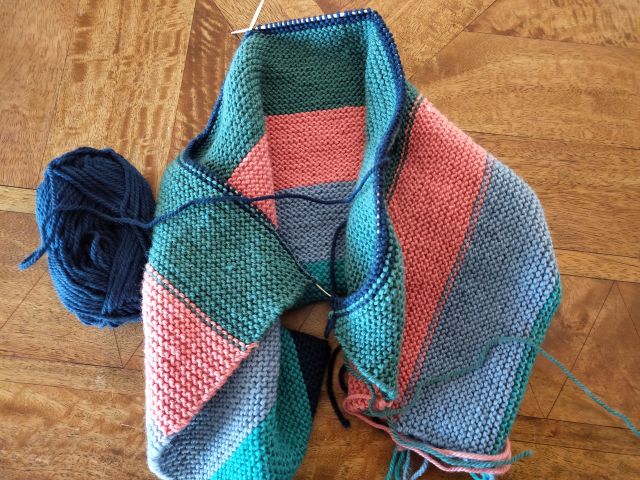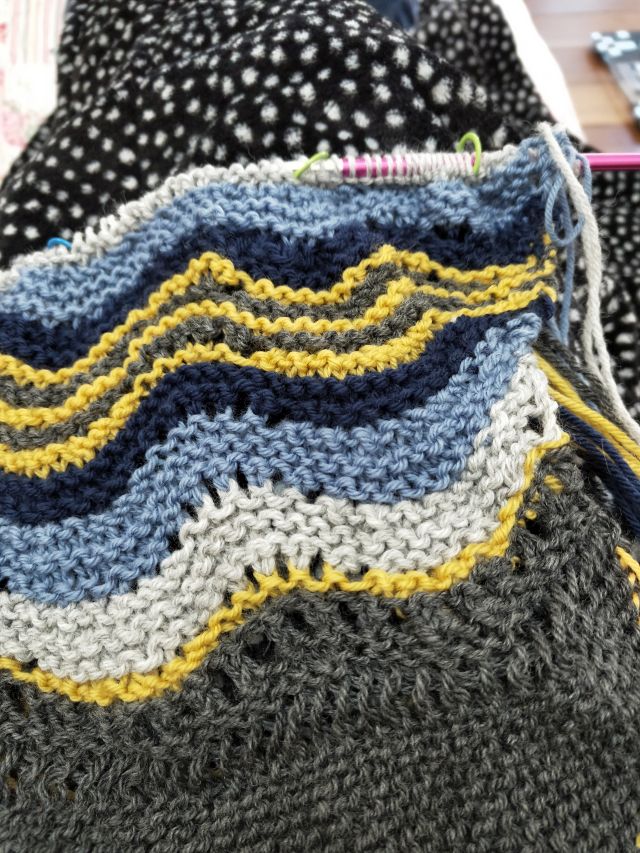
I am currently working on the inner triangle section – I love how the yarn overs at the start have a lace-like effect (we are going to pick up along these edges).
I made myself a new project bag – for my Hansel shawl.
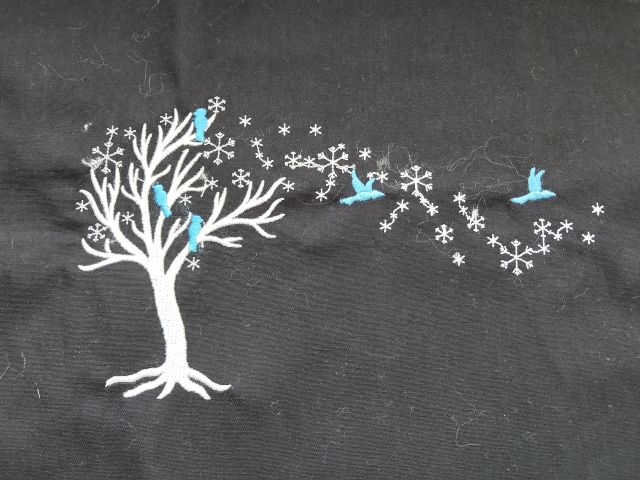
The embroidery is from Urban Threads. I made embroideries for the front and back, then quilted each piece and then made a lined zipper bag.
I might have made it slightly too small – you can see it’s packed, but if it doesn’t work for this project it will work for other projects (maybe a cross stitch project)
I have become quite monogamous on this cross stitch.
The motif in the upper-right corner created a lot of difficulty for me. I think I stitched it three times before I could get the outer border to join correctly. The blue marking lines helped enormously. I have put more in to make the last few motifs easier and then it is on to the alphabets.
I’m back to stitching in hand and it just seems to work a bit better for me. I don’t think my stitches are better (in fact I think my tension is probably a bit off), but I am far more likely to pick it up and work on it.
I got a bit carried away with buying new charts last year and now I feel a bit anxious about the amount of unstitched charts I have.
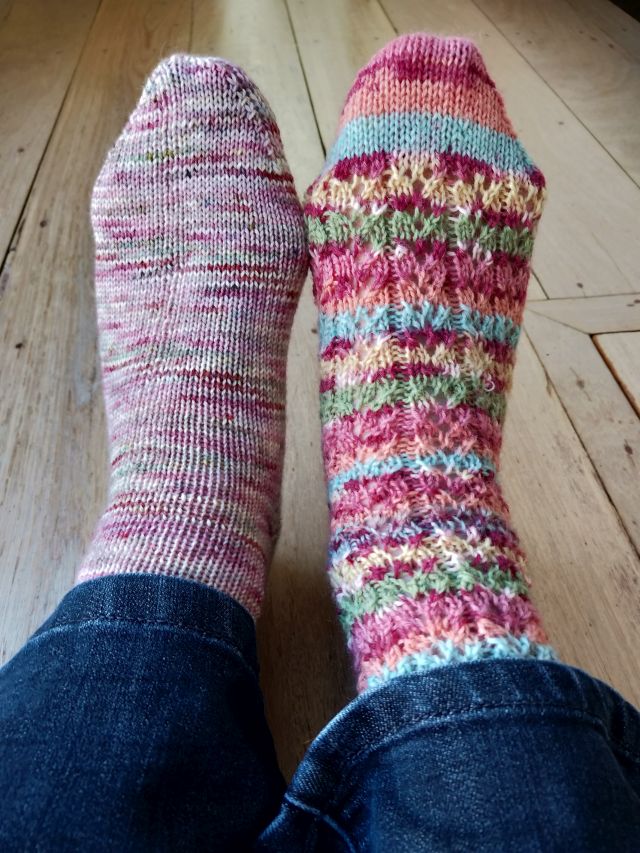
I made these socks for a friend. It is my take on the Wildflowers and Honeycomb socks. I used the stitch pattern for the cuff, leg stitches and heel flap, but worked out my own numbers based on my gauge and did a wedge toe.
I have had this book since it was published and the fact that it has taken this no long to read is no indication of its quality more a sign of my book piling.
This Thing of Paper is a knitting book that urges you to make stuff. Karie Westermann was inspired by her lifelong fascination with books and how all her favourite volumes all fit just so in her hands (much like her favourite pair of knitting needles!). Eleven knitting patterns explore the connections between books and knitting, while the accompanying essays take you from medieval monasteries to contemporary libraries. What does it mean to be a maker? What do handmade things mean to us? Who do we become as we read and knit? All these questions and many more are discussed in a knitting book quite unlike others. The book comes complete with the patterns written in Karie’s signature style, lush photography shot on location, and bespoke graphic design.
This is a fabulous book if you are interested in knitting, books, and the history of books. The essays are interesting and thought provoking and don’t take long to read. You could dip in and out of this book – just read an essay now and then. I read it from start to finish in a couple of sittings.
I am keen to have a go at a Hap shawl and thought I might attempt the Woodcut Shawl – although I am going to start with a simpler one first. I am doing the Shetland Hap Shawl class at Craftsy.
I didn’t think I achieved that much last year, but when I look back it wasn’t too bad.
I finished 5 pairs of socks – my nighthawk ones are my favourite, three project bags (I think this is a sign I have too many projects), my Hap for Harriet and my Live Simply cross stitch (which I did as part of a Craftsy course).
The Pi embroidery is a design I bought from Urban Threads a while ago (maybe a year) with plans to make a project bag. Originally I planned black on white, but then I saw this embroidery and thought white on black was very effective (I have this design too – already stitched out).
I just made a simple lined draw string bag – Martha Stewart has a great video tutorial.
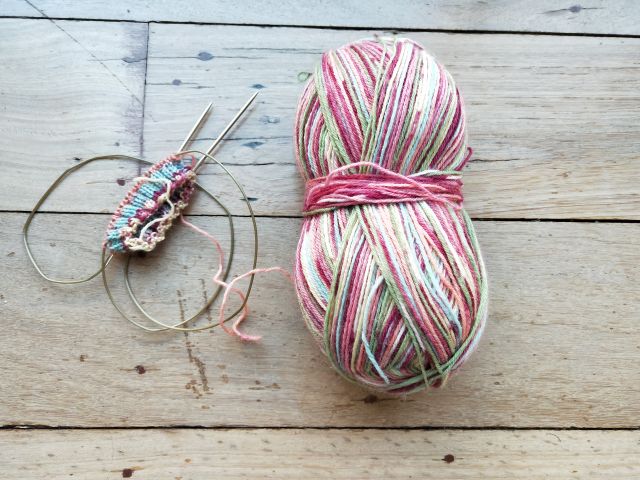
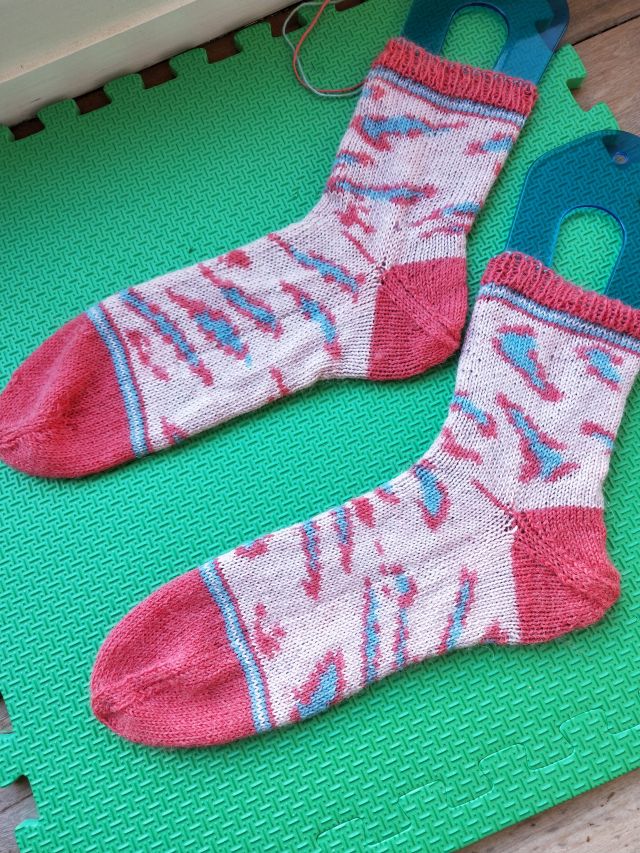
The pattern on the leg and the top of the foot are from the Hermione Everyday Sock pattern, but I used my own ‘recipe’ for the sock. The yarn is Rhichard Devrieze – Peppino. One skein is 65g, which might be enough for a pair of socks, but I didn’t want to risk it, so bought two skeins. I’m using 2.25mm knit pro zings (magic loop method).
I have bought a few of Kate’s knitting books – Colours of Shetland, Yokes, Inspired by Islay and The West Highland Way – and I am currently knitting Braid Hills Cardigan. I also follow her blog. I was very keen to read this book as I find her knitting essays to be thoughtful and eloquent.
I wasn’t disappointed. This is a very personal memoir of a person who had a stroke and their subsequent rehabilitation and recovery. It is a positive and thought provoking look at illness, feminism, disability, ability, knitting an design. It has made me think about the world and how I move through it with my able body. It has made me think about the design of the objects in my life and how U put up with poor design (because being able-bodied I can). For example, my sewing table is the wrong height and the gap for the chair is in the wrong place, inconvenient but still usable. However, I notice I don’t sew as much as I would like.
Every chapter was interesting. I kept thinking this is my favourite only to move onto the next one and think ‘no this is my favourite’. It made me think about brain injury and how because it is invisible we might not be as sympathetic or as accommodating as we should be – for example, when we are in a crowded space behind a slow moving person, etc.
It also made me think about community – our local community, our knitting community, etc and the connections we make.